What changed in SeptemberThis is a rundown of what has changed in the collar firmware since the last issue, from v1.19.0 up to v1.23.1, which is current as of 3 October. September was mostly about three things: sound, time, and keeping a collar going when something on it breaks. A lot of it came out of a habit we’ve settled into here, which is pulling the memory cards out of our own test collars every day or two and reading what the collars wrote about themselves. That is how most of the fixes below were found. It also means we have gotten very, very good at unscrewing and rescrewing enclosures. Further down there’s hardware news: the first batch of CollarIDs is sold out, the first CollarDTs are on their way, there’s a second approved memory card, and the redesigned app is on its way back. | ||||
If you only do one thing: update your collars to v1.23.1. | ||||
Why so much of this is about memoryMemory got expensive this year. The chips inside SD cards are the same ones AI data centers are buying up, and card prices have followed. A 128 GB SanDisk High Endurance card went for about $13 to $15 on sale through 2024 and 2025, and today SanDisk lists it at $37. The jump is even bigger for large cards: a 2 TB SanDisk card sold for about $160 to $180 through 2025 and now runs roughly $390 to $560, depending on the store. Cards have also become harder to get in quantity. A collar that records sound lives or dies by its card, so we put a lot of September into two things. The first is audio compression, so the same recordings take a third of the space and every card goes further. The second is testing other cards that are cheaper or easier to find than the one card we had approved. Both are below. | ||||
What landed | ||||
|
v1.21.0 and v1.22.0 · 22 to 27 Sep
Sound in a third of the space
Recordings can now be stored in a compressed format called FLAC, and on new configurations that is the default. It is the same sound with nothing thrown away, in about a third of the card space, so roughly three times as much sound fits on a card. The website plays the files directly and the card estimate follows the setting. Configurations already set to WAV, the uncompressed format, keep recording WAV. To put a number on it: recording around the clock at 16 kHz, a 128 GB card now lasts about four and a half months, where WAV filled it in about six weeks. At 8 kHz it is about nine months. That is card space only; whether the battery keeps up depends on your schedule and the sun, which the Configure page estimates for you. | ||||
|
v1.22.0 · 27 Sep
Loud sounds no longer clip
Loud sounds like handling noise and close calls used to distort. They now come through clean. The trade is that recordings are quieter at the same setting, so if you want the old loudness, choose High where you used to choose Default. The website’s player brings older and newer recordings to the same level when you mix them. | ||||
|
v1.20.0 · 17 Sep
Schedules that follow the calendar
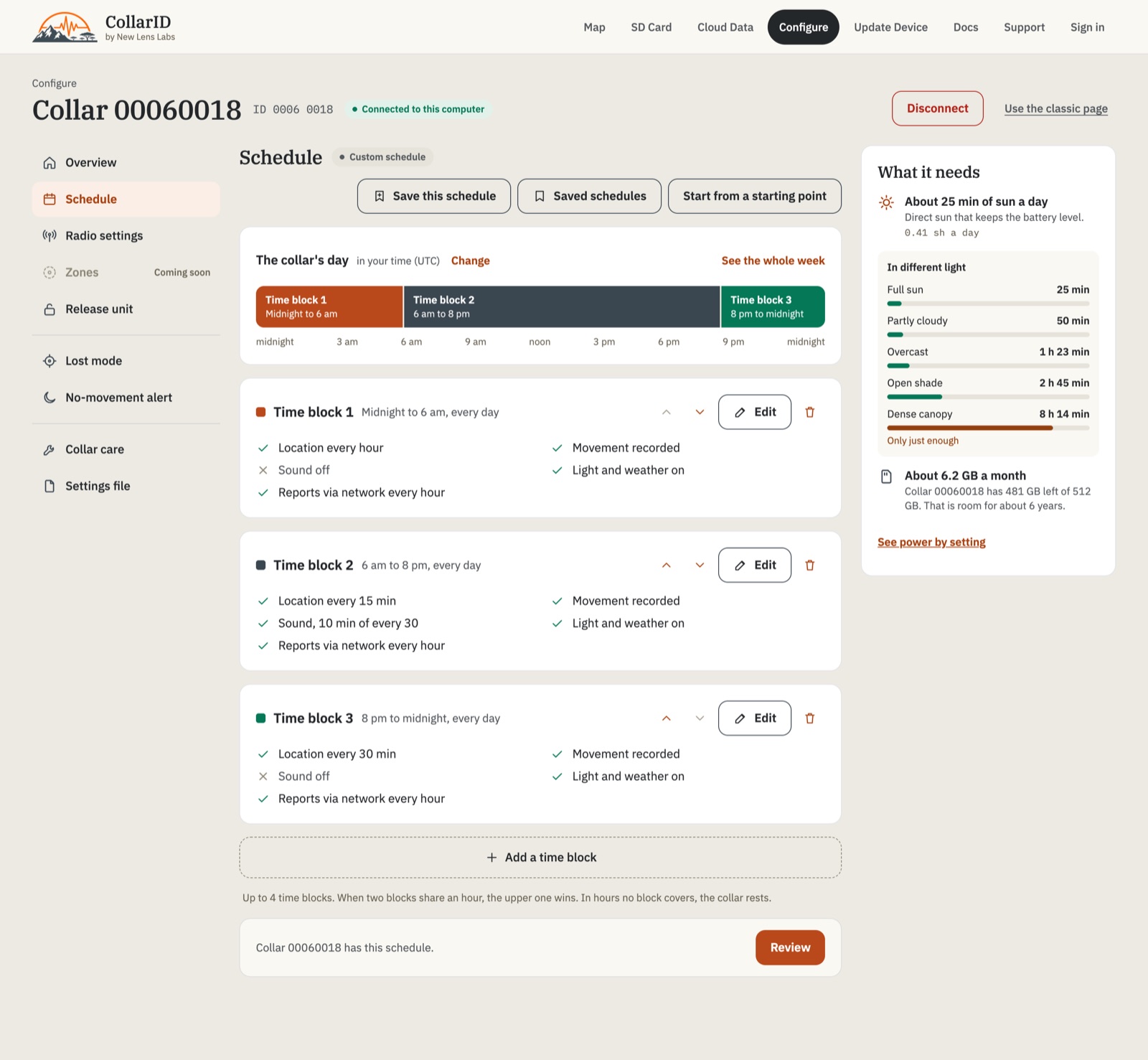
A schedule can be limited to certain days of the week or to a date range, so a weekend beacon or a rut-season recording plan switches itself on and off with nobody near the collar. On the Remote Schedule page you can book a change for a future date, and a list of booked changes makes a season plan. Remote changes also got lighter: a small one takes one message instead of three, and it confirms in minutes instead of the better part of an hour. | ||||
|
v1.23.0 · 3 Oct
A clock that corrects itself
The collar now learns from GPS how fast its own clock runs, and trims it. Between fixes it holds time to about a tenth of a second a day, where it used to drift 5 to 6 seconds a day. Since v1.22.0 every recording also comes with a small companion file that ties it to the collar’s clock, so sound and movement line up on one timeline. | ||||
|
v1.23.0 · 3 Oct
Location protection
Reports sent over LoRaWAN have always been encrypted, so nothing changes there. The gap was the direct radio, which some of you use instead of LoRaWAN or alongside it, where anyone with the right receiver could read a collar’s position. That gap is now closed. Give a collar a key from the website (on the Configure page, under Radio settings) or from the app, and everything it sends over the direct radio is sealed, its regular reports and its lost-mode signal alike. Only a receiver that holds the key, and your CollarID account, can read where the animal is. The website shows when the collar has confirmed its key. | ||||
|
v1.21.0 and v1.22.0 · 22 to 27 Sep
Collars that keep going
A failing memory card no longer stops a recording or restarts the collar, and a recording cut off by a fault is repaired at the next start. A light sensor, compass or air sensor that stumbles is recovered instead of taking the collar down with it. Collars also report their own restarts now, and the map flags one that keeps restarting. | ||||
Same rule as last time: this works on the bench and it’s in the firmware, but it hasn’t had the field time the rest of this list has. Start with a few collars rather than the whole fleet, and tell me what you see. | ||||
|
v1.22.0 · 27 Sep · experimental
Compass streaming and calibration
The compass can record 1, 2, 4, 8 or 16 readings a second to its own files, and it can be calibrated from the app or the website: connect, choose Calibrate magnetometer, and turn the collar slowly through every orientation while the light pulses cyan. One thing to know before you rely on it: a sudden power loss can lose up to the last 20 minutes of compass readings, because they are held in memory to save battery. | ||||
| ||||
| ||||
Hardware and what’s coming | ||||
|
CollarID · first batch
The first batch of CollarIDs is sold out
The entire first batch of CollarIDs is sold. The devices arrive at our office in the next three to four weeks. They get tested here first, and then they go out to the people who ordered them. We’re also preparing a much larger manufacturing batch, so there will be devices on hand later this year. If you missed this one, write to me and I’ll make sure you hear when they’re ready. | ||||
|
CollarDT · first manufacturing run
The first 30 CollarDTs are coming
The first manufacturing run of CollarDT, the detachment module, is 30 devices, and they are on their way to us. They go through testing here as well, and they should be ready for sale in about a month. If you want one, write to me. | ||||
|
In progress
A Handheld Receiver is in the works
We are working on a Handheld Receiver. It will make things easier for people who can’t set up a LoRaWAN gateway, or who are tracking animals that are out of range of one. It isn’t something we sell or support yet. I’ll write more when there’s something to hand over. | ||||
|
Website
The configurator, redesigned
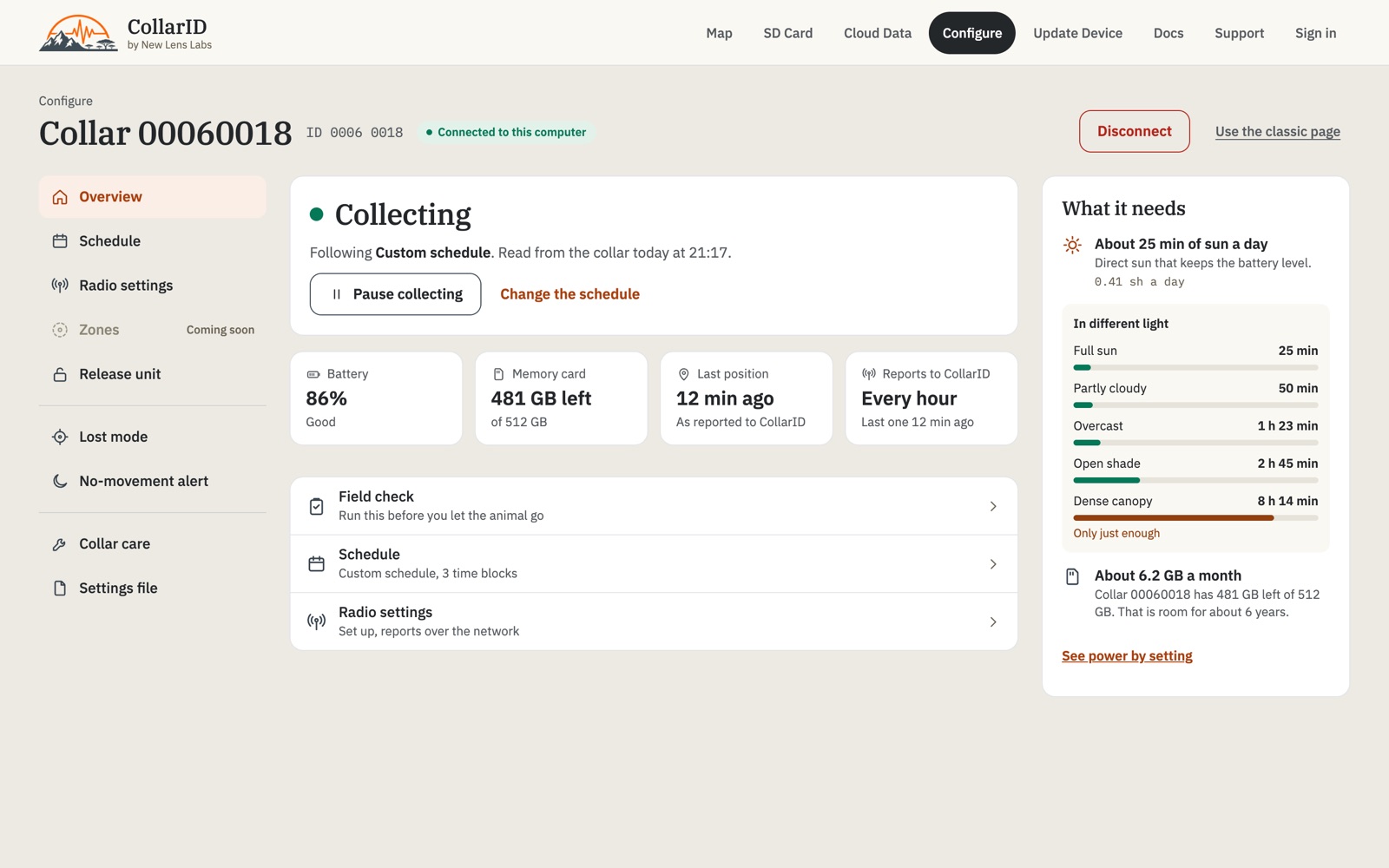
The Configure, Schedule and Detach pages on the website were rebuilt at the end of September. The idea was to put what you actually want to know up front: whether the collar is collecting, how much card is left, and how much sun the schedule needs to keep the battery level. The settings underneath are the same ones as before, and the classic pages are still there if you prefer them.
| ||||
|
Mobile app
Redesigned, and on its way back
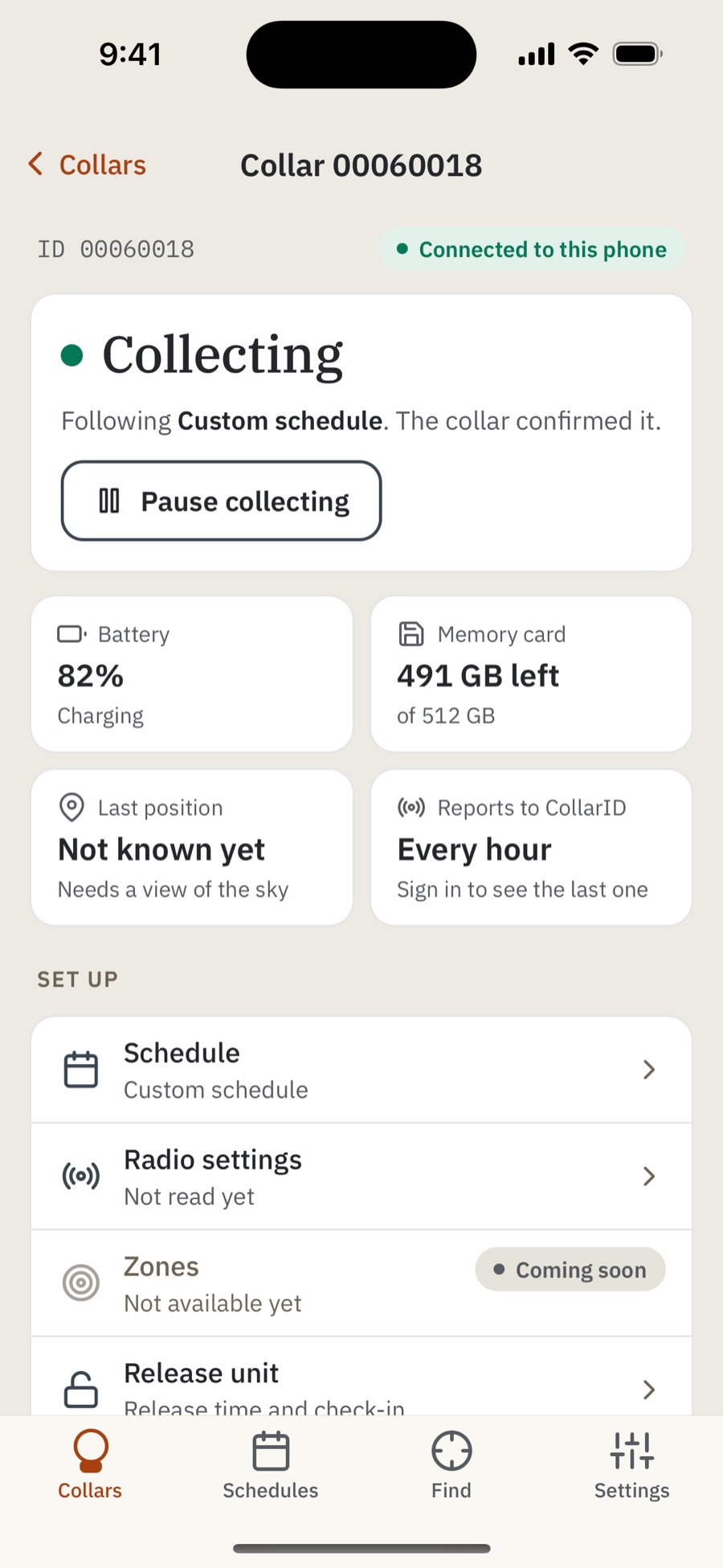
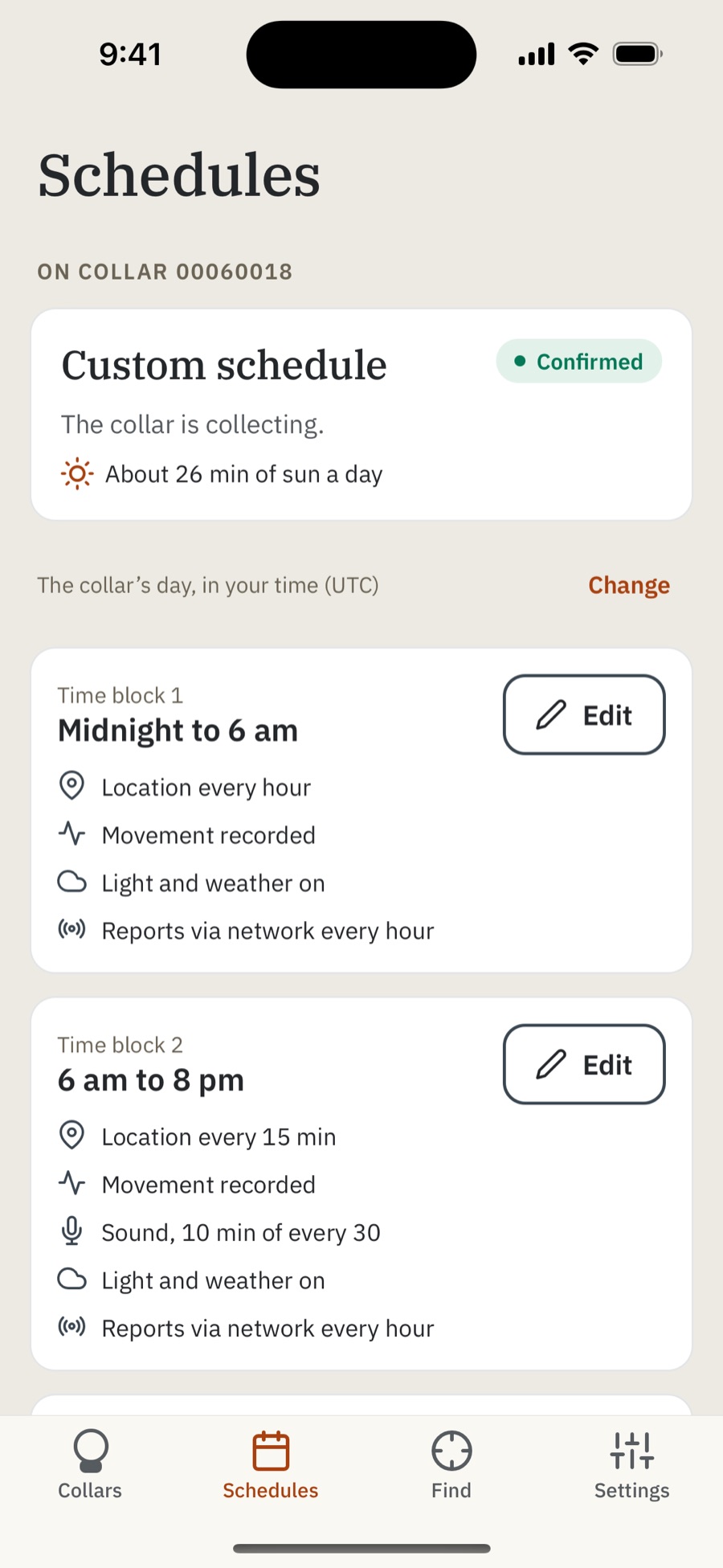
The app got the same redesign, so the app and the website now look and work alike. We are preparing to release the iOS version imminently and are just waiting on Apple to approve the developer account. Android will follow shortly. That is a little later than I said last time.
| ||||
|
SD cards
Memory cards: a second option
This is the other half of the memory work from the top of this issue. Until now Kioxia Exceria Plus was the only card we approved. SanDisk Extreme and Extreme Pro are still not supported. We spent a good part of September on the SanDisk High Endurance 128 GB. We ran a multi-day test and found a way to format the card that avoids the failures we saw. A longer test is running now, but we are approving the SanDisk High Endurance as an alternative in the meantime: the latest firmware operates it much like the Kioxia. We still need to measure that it uses about the same battery as the Kioxia. Two things matter if you want to use one. For now it has to be the 128 GB card, and we plan to open that up to the other sizes in a later release. It also has to be formatted the way we found, which is not what a computer does by default. Write to me before you buy a stack of them and I’ll send you the steps. | ||||
|
| ||||
|
If your collars are on anything older than v1.23.1, this is a good time to update. The sound and clock work from this month is in there, and the experimental features are off unless you turn them on.
Full release notes are at collarid.org/changelog. | ||||
|
Most of what’s in this issue started as something a collar told us about itself, or something one of you wrote in about. So if your collar does something strange, or you want it to do something it can’t, write to me. That’s still how the list of what to work on next gets made. Patrick Patrick Chwalek, PhD · New Lens Labs | ||||